
About
Hardware and software, built as one system
I work on the boundary where physical circuits meet the code that drives them. Most of my effort goes into how the parts fit together.
Background
Engineering from the bench up
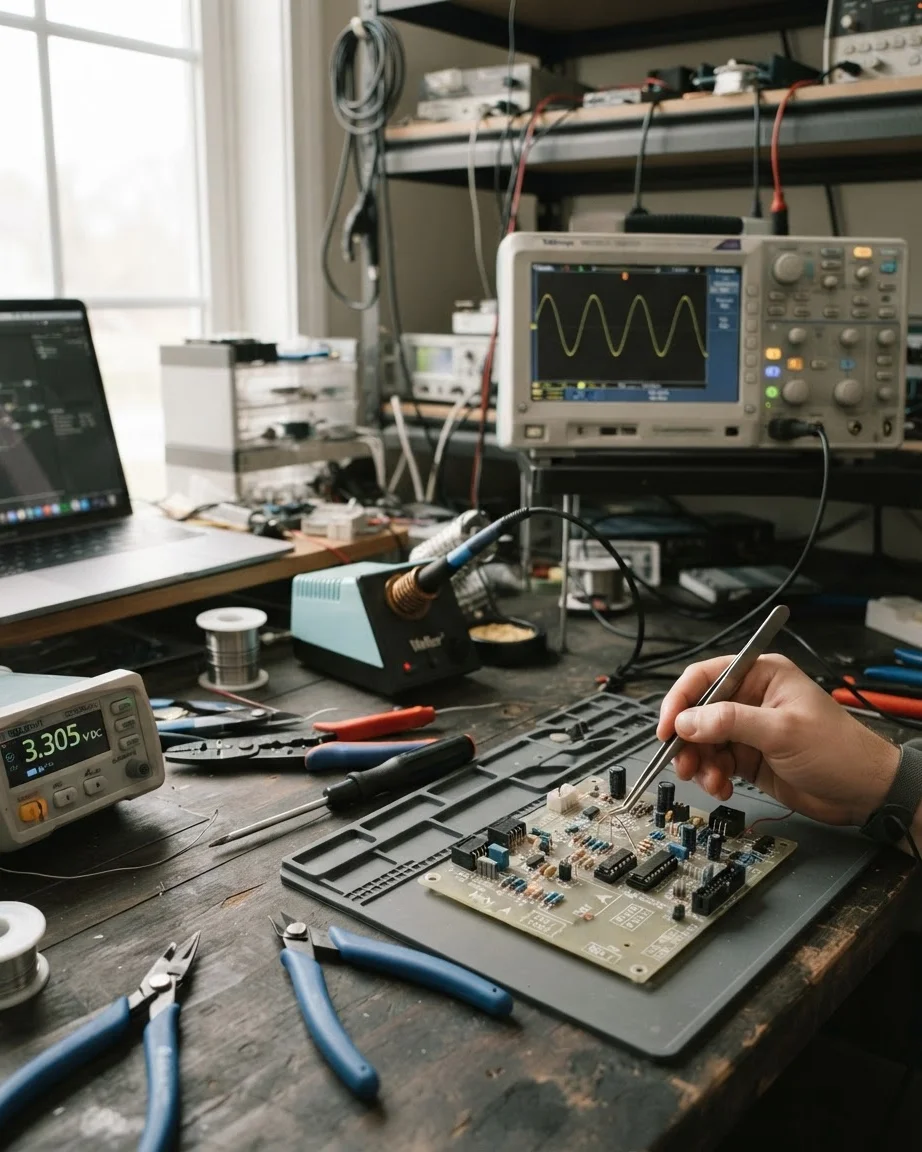
My foundation is hands-on: a workbench with oscilloscopes, soldering tools, and boards in various states of assembly. I started with physical hardware, learning how signals behave on real traces and how a small timing error can ripple into a system-wide fault. That grounding still shapes my work. I treat software as one layer of a larger electrical and mechanical system, and I want to understand the physical constraints before I write the first line of firmware.
Today I focus on embedded and hardware-adjacent systems, where the trade-offs between power, speed, memory, and reliability are visible and measurable.
Process
How I move from schematic to working firmware
01
Schematic design
I define the signal paths, power domains, and interfaces first, and document each design choice so the reasoning stays legible to collaborators.
02
PCB layout
I route traces with signal integrity in mind, keeping return paths short and noisy lines separated from sensitive analog sections.
03
Bench testing
I bring up boards methodically, checking rails, clocks, and timing with an oscilloscope before trusting any higher-level code.
04
Firmware debugging
I write firmware to behave deterministically, then trace faults back through the hardware to find where the software and the physical system disagree.